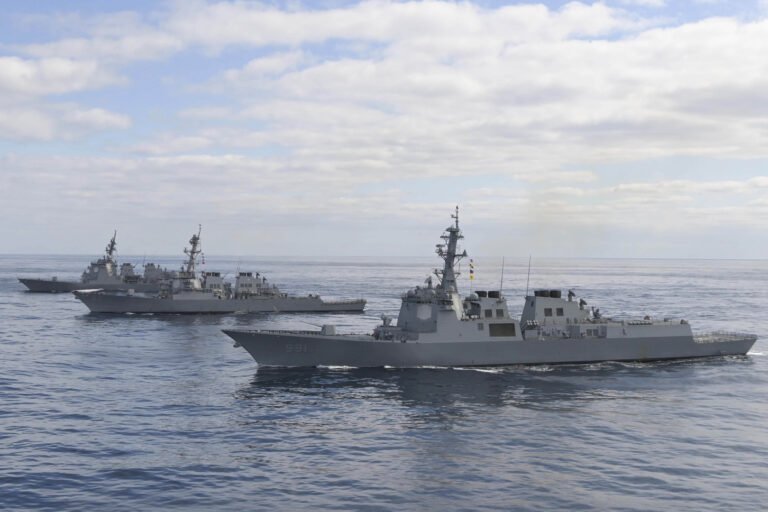
Seoul, South Korea – In a move with strategic implications beyond routine naval exercises, South Korea announced its first joint maritime search and rescue drill with Japan in nine years.
The drill is scheduled to begin on June 7 southeast of Jeju Island. A South Korean amphibious assault ship and a Japanese destroyer equipped with the Aegis system will participate. This initiative aims to overcome historical tensions that have long hampered security cooperation between the two countries.
Breaking the 9-year stalemate
This move follows a bilateral meeting between Japanese Defense Minister Shinjiro Koizumi and his South Korean counterpart, Ahn Gyu-bak, on the sidelines of the Shangri-La Dialogue summit in Singapore. The exercise, which began in 1999, serves as a coordination mechanism in the event of maritime incidents. However, it has been suspended since 2017 following a deterioration in bilateral relations, particularly after a 2018 incident involving a Japanese patrol aircraft flying over a South Korean vessel.
This renewed cooperation comes as the two leaders, Japanese Prime Minister Sanae Takaichi and South Korean President Lee Jae-myung, seek to move beyond the legacy of Japanese colonialism (1910-1945), which for decades has hindered any serious rapprochement, in order to focus on current geopolitical challenges.
American pressure and a change in the rules of the game
These moves coincide with intensified US pressure to boost Asian military spending. In his address at the Shangri-La Dialogue, US Secretary of Defense Pete Hegseth delivered a firm message to allies, asserting that “the era of the United States supporting the defense of wealthy nations is over.”
Hegseth urged Asian partners to become self-reliant and bear the costs of their own security. He emphasized that strong alliances require “partners, not protectorates.”
Higgseth warned of China’s “unprecedented” military buildup, stressing that the dominance of any major power in the Pacific would destabilize the global balance of power.
These concerns come at a time when Seoul and Tokyo are increasingly worried about China’s growing influence and North Korea’s nuclear ambitions. This concern, coupled with American encouragement, is pushing them to set aside their security differences.
overlapping priorities
South Korea and Japan find themselves facing common challenges today; they rely on the Middle East for energy supplies and on the American security umbrella for protection, amid doubts about the current US administration’s commitment to the region.
Therefore, deepening their defense partnership and discussing military logistics support agreements are no longer options but rather security imperatives.